Searching for a marriage counselor near you can feel overwhelming when your relationship already has you emotionally drained. You want someone who actually understands what you’re going through, not just any therapist with an open slot on their calendar.
Here’s what most people don’t realize: finding the right fit matters more than finding the closest office. A skilled marriage counselor can help you rebuild trust, improve communication, and create the kind of connection you both want. The wrong match can leave you more frustrated than when you started.
At Secure Connection Counseling, we specialize in Emotionally Focused Therapy (EFT), an evidence-based approach designed specifically for couples seeking to repair and strengthen their bond. Working with couples in Southern Utah and through telehealth, we’ve seen firsthand how the right therapist changes everything about a couple’s trajectory.
This guide walks you through exactly how to find, evaluate, and choose a marriage counselor who fits your specific situation. You’ll learn what credentials actually matter, which questions to ask during consultations, and how to recognize whether a therapist’s approach aligns with what you need as a couple.
What marriage counseling is and when to start

Marriage counseling is professional therapy specifically designed to help couples improve their relationship, resolve conflicts, and build stronger emotional bonds. A trained therapist guides you and your partner through structured conversations, helps you identify patterns that cause disconnection, and teaches concrete skills you can use outside the sessions. Think of it as having an experienced coach who can see what you can’t when you’re stuck in your own relationship dynamics.
What actually happens in marriage counseling
Your first session typically starts with both partners sharing their perspective on what brought you in. The counselor asks questions to understand your relationship history, current challenges, and what you each hope to achieve. This isn’t about choosing sides or deciding who’s right. The therapist’s job is to help both of you communicate in ways that actually work.
Most sessions after that initial meeting follow a pattern. You’ll discuss specific issues or recent conflicts, and your counselor will interrupt unhelpful patterns as they happen. They might slow down a heated conversation, point out what’s really being said underneath the words, or help you express needs your partner can actually hear. Between sessions, you’ll often get exercises or approaches to practice at home.
The goal isn’t to eliminate all conflict, but to help you fight in ways that bring you closer instead of pushing you apart.
Different therapists use different methods. Emotionally Focused Therapy (EFT) focuses on attachment needs and emotional responses. Gottman Method looks at conflict management and friendship. Imago Relationship Therapy works with childhood patterns. When searching for a marriage counselor near you, you’ll want to understand which approach matches your situation.
Signs you should start now (not later)
You don’t need to wait until your relationship is in crisis to benefit from counseling. Many couples wait an average of six years before seeking help, which means they’re trying to fix problems that have become deeply entrenched. Starting earlier gives you better odds of repairing what’s broken before permanent damage sets in.
Here are specific situations that call for professional help:
You’re having the same argument repeatedly with no resolution, just exhaustion
One or both of you are considering separation or divorce but haven’t decided yet
Trust has been broken through infidelity, financial deception, or major secrets
Communication has shut down and you’re living more like roommates than partners
You’re navigating a major transition: new baby, job loss, relocation, or empty nest
Physical or emotional intimacy has disappeared from your relationship
One partner struggles with addiction, mental health issues, or past trauma affecting the marriage
You disagree on fundamental issues like parenting, finances, or in-laws
Resentment is building and you catch yourself thinking about life without your partner
Waiting for your partner to change first doesn’t work. Starting therapy means you’re both willing to show up and do the uncomfortable work of looking at your own contributions to the problems. The best time to start is when you still have enough goodwill and energy to invest in the process, not when you’re already emotionally checked out.
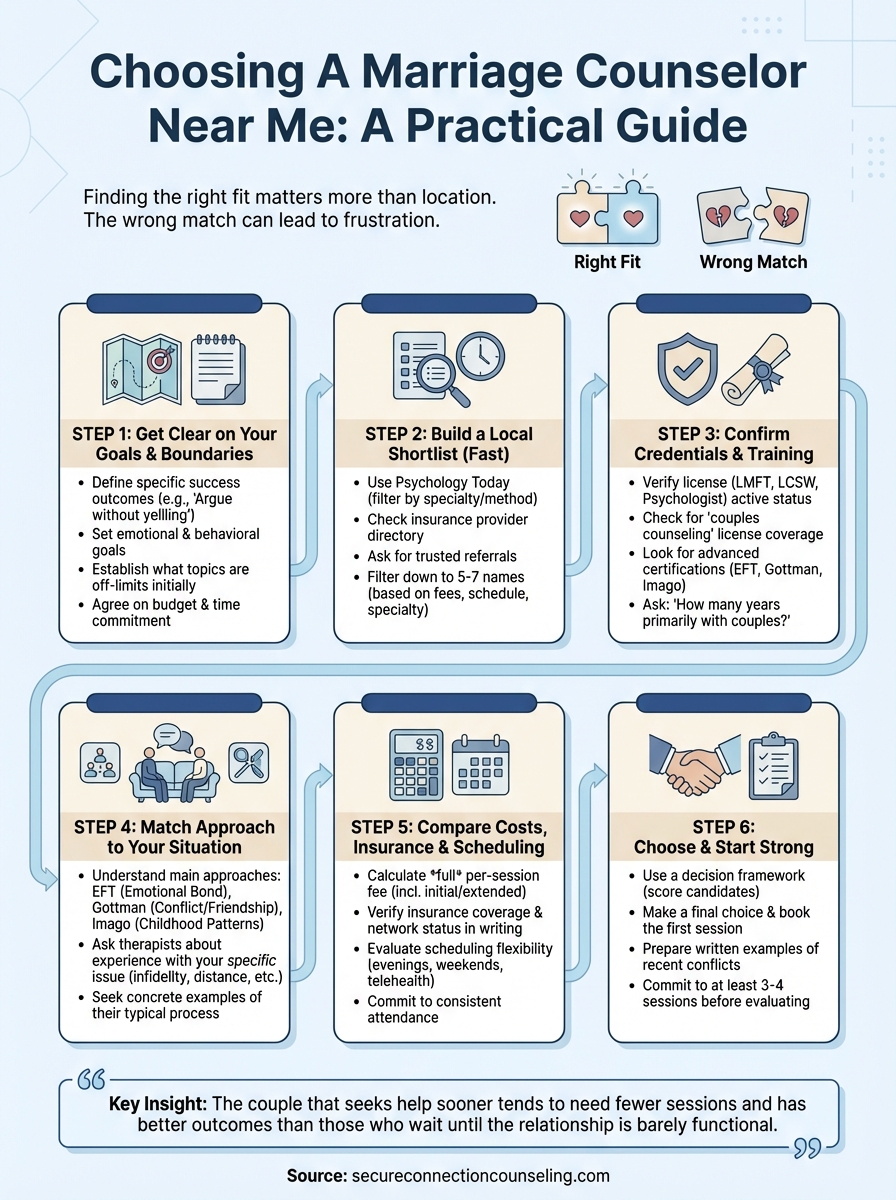
If you’re reading this because you’ve noticed several of these signs, that’s your answer. The couple that seeks help sooner tends to need fewer sessions and has better outcomes than those who wait until the relationship is barely functional.
Step 1. Get clear on your goals and boundaries

Before you search for a marriage counselor near you and start booking consultations, you need to get crystal clear about what you actually want from therapy. Walking into counseling without defined goals is like driving to an unfamiliar destination without a map. You’ll waste time and money working with a therapist who might be excellent but isn’t the right fit for what you specifically need to accomplish.
Define what success looks like for both of you
Sit down with your partner and write out exactly what you want from marriage counseling. Don’t make this a vague wish list like “better communication.” Get specific about what that actually means in your daily life. Does it mean you want to argue without yelling? Do you want to feel heard when discussing finances? Are you trying to rebuild intimacy after an affair, or figure out whether to stay together at all?
The couples who get the most from therapy know exactly what they’re trying to fix before they walk through the door.
Here’s a simple framework you can use together:
Our top 3 goals for counseling:
[Specific outcome, like: “Resolve our disagreement about having another child”]
[Behavioral change, like: “Stop the pattern where I criticize and my partner shuts down”]
[Emotional goal, like: “Feel connected and safe with each other again”]
How we’ll know counseling is working:
[Observable sign, like: “We go a full week without a blowup fight”]
[Feeling, like: “I look forward to coming home instead of dreading it”]
[Action, like: “We’re having date nights again without forced conversation”]
Set boundaries around what you will and won’t discuss
Marriage counseling requires vulnerability and honesty, but that doesn’t mean everything is fair game on day one. Talk with your partner about which topics feel too raw or private to address immediately, and which issues absolutely need to be on the table from the start. This prevents one partner from blindsiding the other during sessions.
You also need to decide on practical boundaries like budget and time commitment. How many sessions per month can you realistically attend? What’s the maximum you’ll spend before reassessing? Having these conversations before contacting therapists saves you from choosing someone who doesn’t fit your constraints.
Step 2. Build a local shortlist fast

Once you’ve clarified your goals, you can start identifying actual therapists who might fit. Your objective here is speed, not perfection. You’re building a working list of 5-7 candidates you’ll evaluate more deeply in the next steps. Most people waste weeks researching every possible option, but you can create a solid shortlist in under two hours using the right approach.
Start with these three search methods
Begin with Psychology Today’s therapist directory, which lets you filter by location, insurance, specialty, and therapeutic approach. Search for therapists within 15 miles of your zip code who list “couples counseling” or “marriage counseling” as a specialty. Look specifically for therapists trained in evidence-based methods like Emotionally Focused Therapy (EFT), Gottman Method, or Imago Therapy rather than generic “relationship counseling.”
Your second source should be your insurance provider’s online directory if you plan to use coverage. Log into your member portal and search for licensed marriage and family therapists (LMFT) or psychologists who accept your plan. Write down names that appear in both your insurance list and Psychology Today, since those therapists have already cleared two filters.
Finally, ask for referrals from people you trust who’ve done couples therapy. You’re not looking for details about their sessions, just names of therapists they found helpful. Your primary care doctor, a trusted friend, or even your individual therapist can point you toward practitioners with strong reputations in your area.
Building a shortlist from multiple sources gives you options without overwhelming yourself with hundreds of profiles.
Filter your initial list down to 5-7 names
Now take your raw list of 15-20 names and eliminate quickly. Open each therapist’s website or profile and scan for these deal-breakers:
They don’t have evening or weekend availability (if you need that)
Their fee is outside your budget with no mention of sliding scale
They have a 3+ month waitlist for new clients
Their approach doesn’t match your needs (like faith-based therapy when you want secular, or only crisis intervention when you need long-term work)
They’re licensed but clearly focus on individual therapy with couples as a side offering
Keep therapists who explicitly list “marriage counseling” or “couples therapy” as a primary specialty, have current availability within 4 weeks, fit your schedule constraints, and work within your budget range. Write down their contact information in a simple spreadsheet with columns for name, phone number, approach, availability, and cost. This shortlist becomes your working document for the next steps.
Step 3. Confirm credentials, licensing, and experience
You’ve narrowed your list to 5-7 potential therapists, but credentials separate qualified professionals from people who just hung up a shingle. Not every counselor calling themselves a “relationship expert” has the training or legal authorization to practice marriage counseling in your state. This step protects you from wasting money on someone who lacks the expertise to actually help your relationship.
Check licensing requirements in your state
Every state requires marriage counselors to hold specific licenses to practice legally. The most common credentials you’ll see are LMFT (Licensed Marriage and Family Therapist), CMHC (Clinical Mental Health Counselor), LCSW (Licensed Clinical Social Worker), or psychologist. Go to each therapist’s website or profile and look for their license number and type listed clearly. You might find other “versions” of therapists, such as Associate Marriage and Family Therapists (AMFTs), who are under supervision while accumulating hours toward full licensure or even MFT Interns who are still in their graduate program toward a therapy degree. Don’t be afraid here! They are often very competent therapists, with many hours of therapy behind them, special skills and training. And because they are supervised you’ll get two sets of therapeutic eyes on your case.
Verify the license is current and unrestricted by searching your state’s professional licensing board database. Most states have online lookup tools where you enter the therapist’s name or license number to see their status. You’re checking for three things: active status, no disciplinary actions, and whether the license actually covers couples counseling. An individual therapist might be licensed but not trained to work with relationships.
If a therapist can’t easily show you their credentials or gets defensive when asked, that’s your signal to move on.
Use this quick verification checklist for each therapist:
Credential verification checklist:
Full name and license type visible on website or directory
License number provided
Confirmed active status through state database
No disciplinary actions or restrictions
Licensed for at least 2-3 years (shows established practice)
Verify specialized training in couples therapy
A license proves someone can practice therapy, but specific training in marriage counseling matters more than general credentials. Look for therapists who’ve completed advanced certifications in evidence-based couples therapy methods like Emotionally Focused Therapy (EFT), Gottman Method, or Imago Relationship Therapy. These programs require hundreds of hours of specialized training beyond basic licensing requirements.
Check each therapist’s profile for phrases like “EFT certified,” “Gottman trained,” or “advanced training in couples therapy.” Experience counts too. Ask directly during consultations: How many years have you worked primarily with couples? What percentage of your practice focuses on marriage counseling? You want someone who spends most of their time working with relationships, not a generalist who occasionally sees couples. When searching for a marriage counselor near you, prioritize practitioners who can point to both formal training and substantial hands-on experience specifically with relationship dynamics.
Step 4. Match the approach to your situation
You’ve verified credentials, but the therapist’s specific methodology matters as much as their license. A couples therapist trained in one approach might excel at helping partners rebuild after infidelity, while another specialist handles communication breakdowns better. Matching the therapeutic approach to your specific situation increases your chances of making real progress rather than spinning your wheels in sessions that feel generic.
Understand the main therapy approaches
Different therapy models target different relationship problems. Emotionally Focused Therapy (EFT) focuses on attachment bonds and works exceptionally well when partners feel disconnected or one person has shut down emotionally. If you’re dealing with distance, lack of intimacy, or feeling like roommates, look for EFT-trained therapists when searching for a marriage counselor near you.
The Gottman Method emphasizes conflict management skills and friendship building. This approach fits couples who argue frequently but want to learn how to fight productively. Gottman therapists teach concrete tools for managing disagreements before they escalate. Imago Relationship Therapy connects current conflicts to childhood patterns, which helps if you notice you’re repeating dynamics from your family of origin.
The right therapeutic approach addresses the root cause of your specific problems, not just surface symptoms.
Here’s how to match your situation to an approach:
Ask about their experience with situations like yours
During initial consultations, be direct about your specific situation. Use this template to get clear answers about whether the therapist has relevant experience:
“We’re dealing with [specific issue]. How many couples have you worked with who face this particular challenge? What approach do you typically use, and what kind of timeline should we expect for seeing progress?”
Listen for concrete examples in their response, not vague reassurances. A therapist with relevant experience will reference similar cases without breaking confidentiality and explain their typical treatment plan. They should outline what the first few sessions will focus on and what kinds of homework or exercises you’ll practice between appointments. If they can’t articulate a clear approach for your situation, keep looking.
Step 5. Compare costs, insurance, and scheduling
Financial and logistical factors determine whether you’ll actually follow through with therapy or quit after a few sessions. You’ve narrowed your list to therapists who match your needs and have the right credentials, but affordability and availability decide who you can realistically work with long-term. Most couples need 12-20 sessions to see significant improvement, so the cheapest per-session rate means nothing if you can’t afford consistent attendance or the appointment times never work with your schedule.
Calculate the actual cost per session
Contact each therapist on your shortlist and ask for their full fee structure in writing. A standard session typically runs $150-$250 depending on your location and the therapist’s experience level. Don’t just ask about the hourly rate. Find out if they charge differently for initial consultations, whether extended sessions cost more, and if they require payment upfront or bill you after.
Use this comparison template when contacting potential therapists:
Cost comparison template:
Per-session fee: $_____
Initial consultation fee: $_____
Sliding scale available: Yes / No
Payment required: Before session / After session / Monthly
Accepted payment methods: _____
Cancellation policy: _____
Late cancellation fee: $_____
If you’re paying out of pocket, ask whether they offer a sliding scale based on income. Some therapists reduce their rate for couples with financial constraints, but they won’t advertise this publicly. You have to ask directly.
Navigate insurance coverage efficiently
Call your insurance provider before contacting therapists to understand your mental health benefits for couples counseling specifically. Many plans cover individual therapy but exclude marriage counseling, or they limit the number of sessions per year. Ask these exact questions: What’s my copay for outpatient mental health? Does my plan cover marriage counseling or only individual therapy? How many sessions are approved per calendar year?
Get the answers in writing through your insurance portal rather than relying on phone conversations, because coverage disputes happen frequently.
Once you know your benefits, verify that each therapist is actually in-network by having them run your insurance information during the consultation. Out-of-network therapists might provide superbills for you to submit for partial reimbursement, but you’ll pay upfront and wait weeks for reimbursement that might only cover 50-60% of the cost.
Evaluate scheduling flexibility
Check whether each marriage counselor near you offers appointment times that actually work for both partners consistently. If one of you travels for work or works evening shifts, you need a therapist with flexible availability or weekend hours. Ask about their cancellation policy, how far in advance you need to book, and whether they offer telehealth sessions when in-person meetings aren’t possible. Couples who can only meet every three weeks due to scheduling conflicts make slower progress than those who attend weekly or biweekly sessions.
Step 6. Choose your counselor and start strong
You’ve done the research, compared options, and verified credentials. Now you need to make a decision and commit to the process. This final step determines whether you’ll actually show up consistently or second-guess your choice after the first session. Most couples who succeed in therapy make a clear decision upfront and give the counselor at least 3-4 sessions before evaluating whether it’s working.
Make your final decision using this framework
Review your shortlist one last time using these decision factors. Assign each therapist a score of 1-5 for each category, then total the scores to identify your top choice:
Decision scorecard:
Credentials and specialized training (weight: 5 points possible)
Experience with your specific situation (weight: 5 points possible)
Cost fits your budget sustainably (weight: 4 points possible)
Schedule works for both partners (weight: 4 points possible)
Consultation felt collaborative and safe (weight: 5 points possible)
The therapist with the highest total score becomes your first choice. Contact them immediately to book your first official session, not just another consultation. If they’re unavailable for several weeks, book the appointment anyway and consider starting with your second choice in the meantime. When searching for the right marriage counselor near you, remember that the best therapist is the one you’ll actually see consistently, not the one with the most impressive credentials who can’t fit you in for months.
Choosing a therapist and showing up consistently matters more than finding the perfect match on paper.
Prepare for your first session strategically
Before your first appointment, write down three specific examples of recent conflicts or disconnection moments. Include what happened, how each of you reacted, and what you wish had happened differently. Bring this written summary to your session so you don’t waste time trying to remember details or disagreeing about facts.
First session preparation checklist:
Complete any intake forms or paperwork ahead of time
Prepare your three conflict examples in writing
Agree with your partner: no blaming, focus on your own behavior
Bring insurance cards and payment method
Arrive 10 minutes early to settle in
Leave phones in the car to eliminate distractions
Discuss with your partner beforehand that you’re both committing to at least four sessions before deciding whether this therapist works for you. One session rarely produces breakthroughs. The real work happens when you practice what you learn between appointments, and that takes time to build momentum.
Next steps
You now have a complete system for finding and choosing the right marriage counselor near you. You’ve learned how to define your goals, build a shortlist efficiently, verify credentials, match therapeutic approaches to your situation, compare costs, and commit to the process strategically. The difference between couples who transform their relationships and those who stay stuck often comes down to taking action within 48 hours instead of continuing to research indefinitely.
Schedule consultations with your top two therapists this week. Book the appointments even if you feel nervous about starting. Your relationship deserves the same priority you’d give to a health crisis or career opportunity. If you’re in Southern Utah or seeking telehealth support, Secure Connection Counseling specializes in Emotionally Focused Therapy for couples who want to rebuild trust and strengthen their connection. Take the first step today rather than waiting for your relationship to deteriorate further.