You’ve probably noticed that different situations bring out different sides of you, a protective part that emerges during conflict, an anxious part that shows up before big decisions, or a critical inner voice that’s hard to silence. These aren’t signs of something wrong with you. They’re actually central to how Internal Family Systems therapy, explains the human mind: as a collection of distinct parts, each with its own perspective, feelings, and role in your life.
IFS therapy offers a structured yet compassionate framework for understanding these internal dynamics. Developed by Dr. Richard Schwartz in the 1980s, this approach treats your inner parts not as problems to fix but as members of an internal system worth getting to know. At Secure Connection Counseling, we use IFS alongside other evidence-based modalities because it pairs well with our focus on attachment and relational healing, helping clients build a stronger relationship with themselves so they can show up more fully in their relationships with others.
This article breaks down the core concepts of IFS, including the difference between parts and the Self, how trauma affects the system, and the practical frameworks (like the 8 C’s and 5 P’s) that guide the therapeutic process. Whether you’re considering IFS therapy or simply curious about how it works, you’ll walk away with a clear understanding of what this approach involves and why it resonates with so many people seeking lasting change.
Why Internal Family Systems therapy matters
You spend a lot of time trying to manage competing feelings and impulses, pushing away uncomfortable emotions, second-guessing your reactions, or wondering why you can’t seem to follow through on what you know would be good for you. Traditional therapy often focuses on changing these patterns or challenging negative thoughts, but IFS takes a different approach. It assumes that every reaction you have, even the ones that feel self-destructive or confusing, serves a purpose within your internal system. When you understand that purpose, you gain leverage to create change without fighting yourself every step of the way.
How IFS addresses what other therapies miss
Many therapeutic approaches treat unwanted behaviors or emotions as problems to eliminate. You might work on cognitive restructuring to change how you think, or learn coping skills to manage symptoms. These methods help, but they can leave you feeling like you’re constantly battling parts of yourself. IFS reframes this entirely by treating your protective responses, anxious thoughts, and even your self-sabotaging behaviors as parts that developed to help you survive difficult circumstances. The goal isn’t to get rid of them but to understand what they’re protecting you from and help them step back when they’re no longer needed.
This shift matters because it changes your relationship with yourself. Instead of viewing your anxiety as a defect or your anger as something to suppress, you start seeing these responses as adaptive strategies that once served you well. When internal family systems therapy explained through this lens, it becomes clear why so many people feel relief early in the process: they’re finally allowed to approach themselves with curiosity rather than judgment. The parts that have been working overtime to keep you safe can finally relax when they trust that you’re listening.
“IFS doesn’t ask you to fight yourself. It asks you to get to know the parts that are already working hard on your behalf.”
The ripple effect of understanding your parts
Your internal conflicts don’t stay internal. When you’re unaware of which part is driving your reactions, you carry that inner tension into your relationships, work, and daily decisions. A protective part might shut down communication with your partner when conflict arises. An anxious part might push you to overcommit at work, leaving you exhausted and resentful. IFS helps you identify these patterns in real time so you can choose how to respond rather than reacting on autopilot.
Clients who work with IFS often report changes beyond their initial concerns. They notice they’re less reactive during disagreements, more able to set boundaries without guilt, and better at recognizing when old wounds are influencing present situations. These shifts happen because IFS strengthens your connection to Self, the part of you that can observe, listen, and lead with clarity. As your parts learn to trust your Self, they don’t need to intervene as urgently or as often.
The impact extends to how you parent, lead, and show up for others. When you stop fighting your internal system, you free up energy to be present. You become more attuned to when someone else’s behavior is about their own protective parts rather than about you. This awareness doesn’t just improve your mental health. It changes how you move through the world and how others experience you in return.
The core idea: parts and their jobs

IFS operates on a simple premise: your psyche contains multiple parts, each with its own perspective, emotions, and agenda. These aren’t abstract concepts or metaphors. When internal family systems therapy explained in practice, you learn to recognize parts as distinct voices or impulses you experience throughout your day. The critical voice that tells you you’re not good enough? That’s a part. The impulse to shut down when someone gets too close? Another part. Each one developed to handle specific situations or protect you from specific pain.
The three types of parts in your system
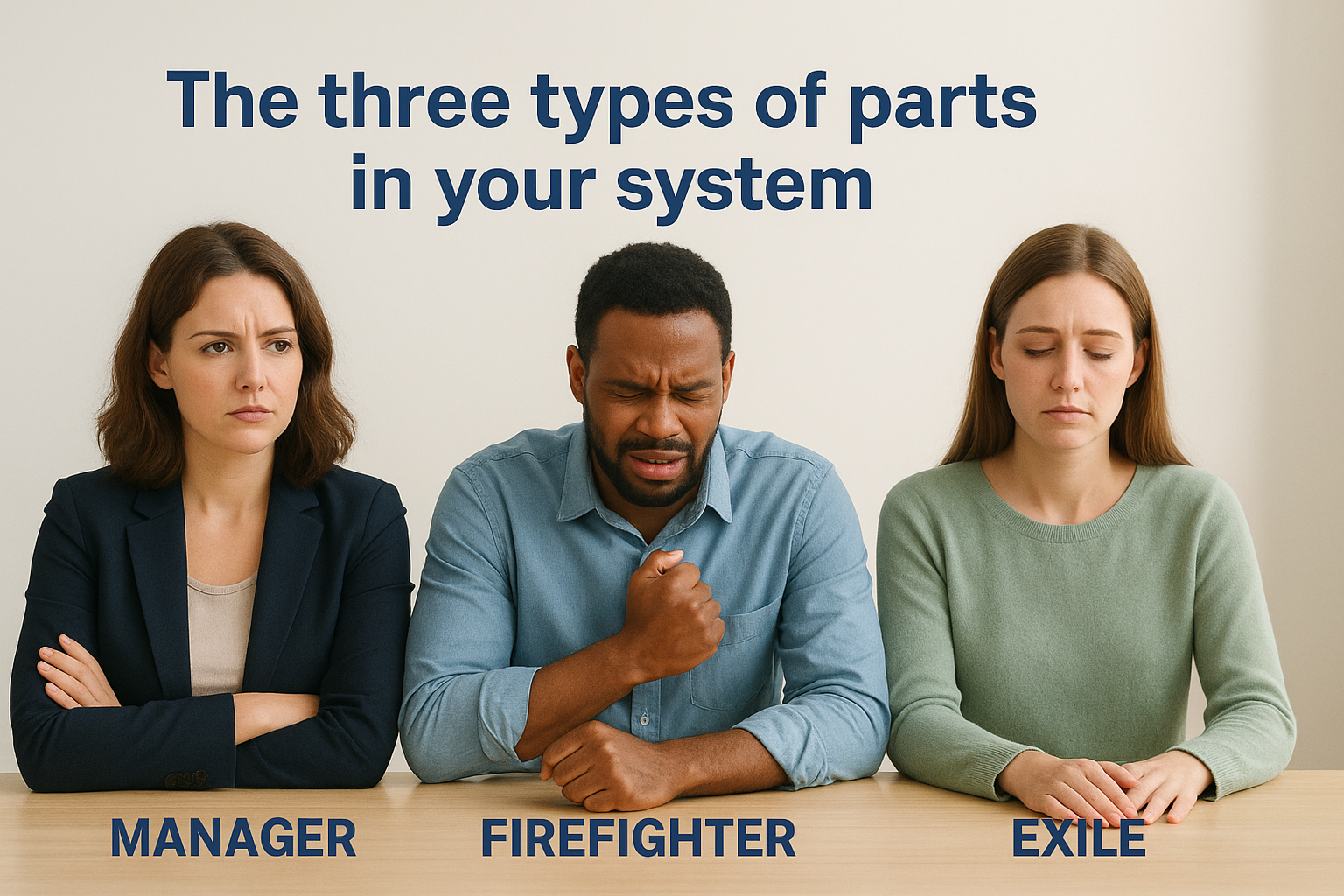
IFS identifies three categories of parts based on their roles. Managers work proactively to keep you safe by controlling your environment and behavior. They’re the perfectionists, planners, and people-pleasers who try to prevent bad things from happening before they start. These parts wake up with you in the morning and spend the day strategizing how to avoid rejection, failure, or vulnerability.
Firefighters react when managers fail and overwhelming feelings break through. They spring into action to extinguish emotional pain as quickly as possible, often through impulsive behaviors like binge eating, substance use, rage, or dissociation. While their methods can be destructive, firefighters believe they’re saving you from unbearable feelings.
Exiles carry the burdens you couldn’t process at the time you experienced them. These parts hold trauma, shame, and early wounds, and they’re usually young. Managers and firefighters work overtime to keep exiles locked away because they fear what would happen if those painful feelings surfaced. The entire protective system exists to prevent you from feeling what your exiles carry.
“Every part has a positive intention, even when its methods cause problems in your current life.”
How parts develop their protective roles
Your parts formed in response to specific experiences, often during childhood or traumatic events. A manager might have learned that staying quiet and invisible kept you safe in an unpredictable household. A firefighter might have discovered that numbing out was the only way to survive overwhelming emotions when no one was there to help you process them. Exiles typically formed when you experienced something your nervous system couldn’t integrate at that developmental stage.
These roles made sense in their original context. The problem arises when parts keep using the same strategies long after the danger has passed. Your protective parts don’t automatically update their threat assessment as your circumstances change. They continue operating as if you’re still in the situations that created them, which is why you sometimes react to present situations with responses that feel disproportionate or out of your control.
Self in IFS: what it is and how to spot it

While parts operate from specific agendas and protective roles, Self represents your core essence, the part of you that isn’t reactive, wounded, or trying to control outcomes. When internal family systems therapy explained through the IFS model, Self isn’t something you need to develop or earn. It’s already present in everyone, though parts often block access to it when they feel it’s not safe to step back. Self possesses natural qualities that emerge when your parts trust you enough to relax their grip on your thoughts and behavior.
The qualities that define Self
IFS identifies eight core qualities that characterize Self, known as the 8 C’s: curiosity, clarity, compassion, calmness, confidence, courage, creativity, and connectedness. You access these qualities not by forcing them but by asking parts to step back so Self can lead. When you’re in Self, you feel genuinely curious about why a part is behaving a certain way rather than judging it. You experience clarity about what’s happening in the present moment instead of getting lost in reactive patterns.
Compassion flows naturally from Self toward both your parts and other people. You feel calm in your body rather than activated or shut down. Confidence arises not from ego but from trusting your ability to handle what comes. You find courage to face difficult emotions without needing to avoid or fix them immediately. Creativity and connectedness emerge as you relate to your internal system and external relationships with more flexibility and presence.
“Self isn’t a part. It’s the presence that can witness, hold, and lead all your parts without getting overwhelmed by any single one.”
Recognizing when you’re leading from Self
You know you’re in Self when you notice a shift in perspective about something that usually triggers you. Instead of immediately defending yourself during criticism, you feel curious about what’s underneath the other person’s reaction. Rather than getting swept into anxiety or anger, you observe these feelings with some distance and can choose how to respond. Your body feels more settled, your thinking less rigid.
Parts-led behavior feels different. When a manager runs the show, you might feel driven, controlling, or hypervigilant. When a firefighter takes over, you experience urgency, numbness, or the impulse to escape. Exiles can flood you with overwhelming emotions that feel disproportionate to the current situation. Self, by contrast, doesn’t feel extreme. It feels grounded, spacious, and able to hold multiple perspectives without collapsing into any single one. The more you practice distinguishing Self from parts, the faster you recognize when you’ve been hijacked and can invite Self back into the driver’s seat.
How IFS therapy works in real sessions
An IFS session doesn’t follow the traditional therapy format where you report problems and receive advice. Instead, your therapist guides you through a process of identifying which parts are present and helping you develop a relationship with them from Self. You start by noticing what comes up for you in the moment, whether that’s a feeling, a sensation, or a thought pattern. Your therapist then helps you get curious about which part is creating that experience and what it wants you to know.
The process of noticing and accessing parts
Your therapist asks you to focus inward and describe what you notice when you think about a specific situation or feeling. You might report tightness in your chest or a critical voice in your head. The therapist helps you recognize this as a part rather than the whole of you. This distinction matters because it creates space between you and the experience. Once you identify a part, your therapist asks how you feel toward it. If you feel curious, calm, or compassionate, you’re in Self and can proceed. If you feel frustrated, scared, or dismissive, those reactions indicate other parts are interfering and need attention first.
Working through the 6 F’s framework
When internal family systems therapy explained in clinical practice, therapists use the 6 F’s to guide the conversation with parts: Find, Focus, Flesh out, Feel toward, beFriend, and Fear. You find the part and focus on it. You flesh out details about what it looks like, how old it seems, and what it’s trying to do for you. You check how you feel toward it and address any parts that don’t want you getting close. You befriend the part by listening to its concerns without judgment. Finally, you ask what it fears would happen if it stopped doing its protective job.
This process takes time. You might spend multiple sessions just getting to know one part before it trusts you enough to step back. Your therapist doesn’t rush you to resolve anything. The goal is to help parts feel heard so they can relax their extreme roles and allow Self to lead your internal system with more flexibility and choice.
Who IFS can help and when to be cautious
IFS works well for a wide range of concerns, but it’s particularly effective when you struggle with internal conflicts or feel like different parts of yourself want incompatible things. You might notice one part pushing you toward connection while another pulls you into isolation, or a part that sets ambitious goals while another sabotages your progress. When internal family systems therapy explained as a method for resolving these inner tensions, it becomes clear why people dealing with relationship difficulties, trauma responses, anxiety, depression, and self-esteem issues often find lasting relief through this approach.
Conditions and situations where IFS proves most effective
You benefit most from IFS when you’re ready to develop a relationship with your internal experience rather than just manage symptoms. People dealing with complex trauma, PTSD, childhood wounds, and attachment injuries often respond well because IFS directly addresses the exiled parts carrying those burdens. The approach also helps when you struggle with behaviors you can’t seem to change through willpower alone, things like emotional eating, relationship patterns, substance use, or self-sabotage, because it addresses the protective parts driving those behaviors rather than just trying to eliminate them.
IFS pairs well with other therapeutic approaches. At Secure Connection Counseling, we integrate it with Emotionally Focused Therapy for couples because both models focus on understanding protective responses and building secure connections. You can use IFS alongside medication management, group therapy, or other individual modalities without conflict.
When IFS may not be the right fit
You need to proceed carefully with IFS if you’re currently in crisis or experiencing active psychosis. The internal focus requires enough stability to turn attention inward without becoming overwhelmed. People in acute crisis often need more directive interventions first. IFS also requires a baseline capacity for self-reflection and emotional regulation. If you dissociate easily or lose track of reality under stress, your therapist needs to establish grounding skills before diving into parts work.
“IFS asks you to build relationships with intense feelings rather than avoid them, which requires readiness and adequate support.”
Some people simply don’t resonate with the parts language or framework. That’s valid. You don’t need to force a model that doesn’t feel right. Your therapist can help you determine whether IFS matches your needs and current capacity, or whether a different approach makes more sense for where you are right now.
Next steps if you want to try IFS
You now understand how internal family systems therapy explained through the framework of parts and Self offers a distinct path toward healing. The approach works when you’re ready to build a relationship with your internal experience rather than fight it. Start by finding a therapist trained in IFS, ideally someone who has completed at least Level 1 certification through the IFS Institute. You can ask potential therapists about their experience with the model and whether they integrate it with other approaches that fit your needs.
If you’re dealing with relationship patterns or attachment wounds, combining IFS with relationally focused therapy can deepen the work. At Secure Connection Counseling, we use IFS alongside Emotionally Focused Therapy to help clients heal both their internal and external relationships. Your parts developed in response to real experiences, and they deserve the same compassion you’d offer anyone who tried their best to survive difficult circumstances. Taking the first step means honoring that truth.