
Discovering infidelity shatters something fundamental: the trust that held your relationship together. If you’re wondering “can a relationship survive infidelity,” you’re likely cycling between hope and devastation, unsure if what you built is worth fighting for.
The short answer: yes, many relationships do survive and even grow stronger after an affair. Research suggests that roughly 60-75% of couples who seek therapy after infidelity choose to stay together. But survival requires more than just deciding to stay, it demands intentional work from both partners.
At Secure Connection Counseling, we specialize in helping couples rebuild trust through Emotionally Focused Therapy (EFT), an evidence-based approach designed to repair attachment bonds. We’ve witnessed couples move from betrayal to deeper connection when both partners commit to the healing process.
This guide walks you through the steps to heal after infidelity, the signs your relationship can recover, and honest criteria for when walking away might be the healthier choice.
What it takes to rebuild after infidelity
Rebuilding after infidelity isn’t a passive process where time alone heals the wound. You need both partners actively engaged in repair work, with the unfaithful partner taking clear responsibility and the hurt partner willing to gradually open back up. Half-hearted efforts from either side will stall recovery and prolong suffering.
Whether a relationship can survive infidelity depends less on the affair itself and more on what happens in the months following discovery. Couples who successfully rebuild typically share three core commitments: complete transparency from the unfaithful partner, emotional safety for the hurt partner to express pain, and professional guidance to navigate the complexity.
Recovery from infidelity is not linear. You’ll have good days followed by setbacks, and that pattern is completely normal.
The dual commitment required
The unfaithful partner must own the damage they caused without defensiveness or blame-shifting. This means cutting all contact with the affair partner, answering difficult questions honestly, and tolerating their partner’s anger and grief. Your job is to prove through consistent behavior that you’re trustworthy, not just declare that you are.
The hurt partner must decide whether they’re willing to work toward Helaing, even when the pain feels unbearable. You don’t have to forgive immediately, but you do need to assess whether you can eventually move forward without using the affair as permanent ammunition. This requires examining your own capacity for repair, not just your partner’s failures.
The realistic timeline you should expect
Most experts agree that healing from infidelity takes 18 to 24 months of consistent effort, though some couples need longer. You won’t feel better month-by-month in a straight line. Instead, you’ll experience intense emotional swings for the first six months, followed by gradual stabilization.
Expect the recovery process to follow these general phases:
Crisis phase (weeks 1-8): Raw shock, emotional flooding, constant rumination about the affair
Understanding phase (months 3-6): Piecing together what happened and why, examining relationship patterns
Restructuring phase (months 7-18): Rebuilding trust through new behaviors, creating safety protocols
Integration phase (months 18+): Processing the affair as part of your history without it defining your present
Recovery takes longer when the unfaithful partner maintains contact with the affair partner, minimizes their actions, or refuses to answer questions. It also stalls when the hurt partner refuses therapy or remains in constant attack mode without allowing any progress.
Step 1. Stabilize and set boundaries now
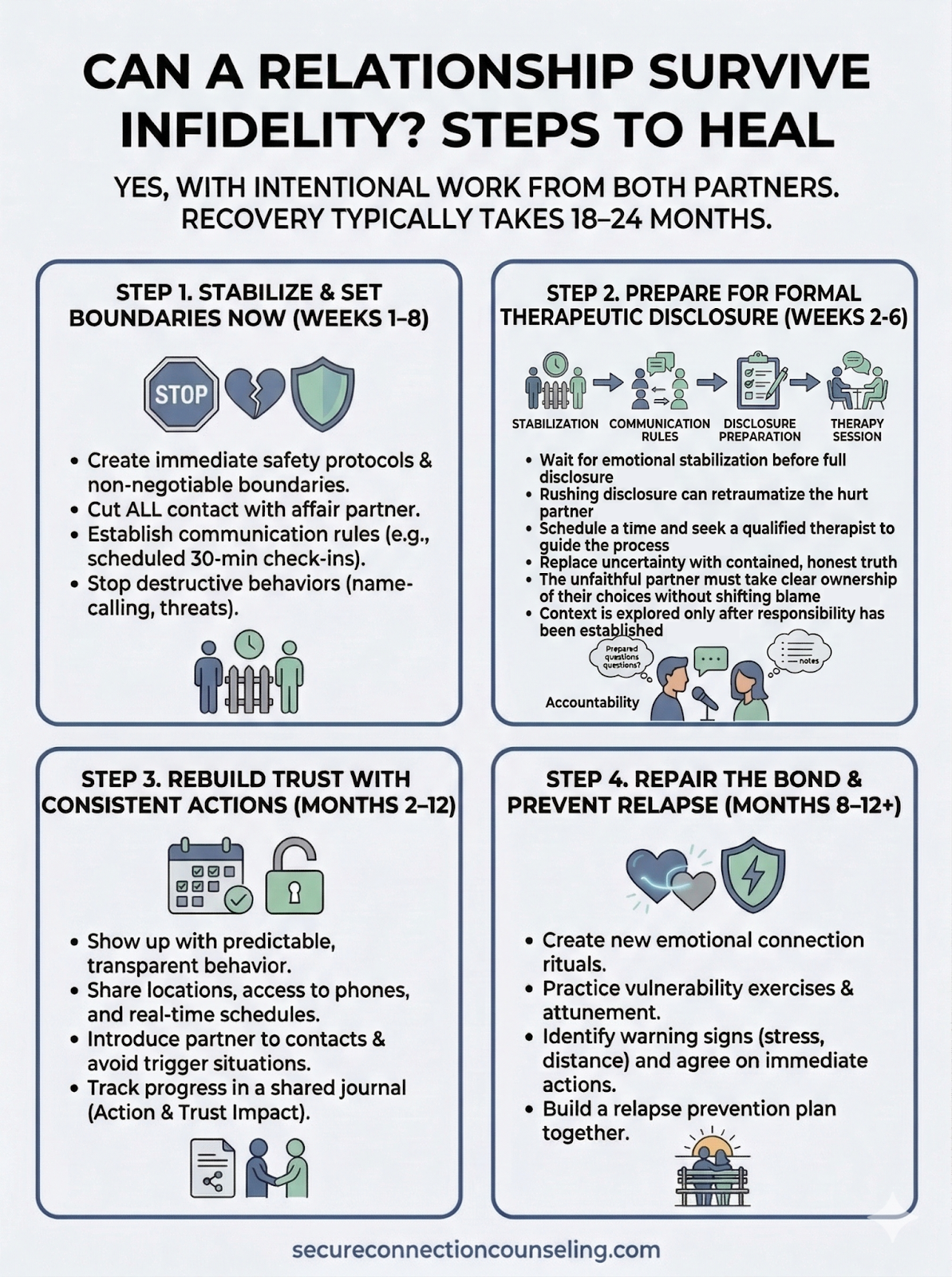
The first days after discovering infidelity feel like emotional chaos, and you need to create immediate structure before anything else. Your nervous system is in crisis mode, and without clear boundaries, you’ll either shut down completely or spiral into destructive patterns. This step happens in the first week, not after weeks of anguish.
Create immediate safety protocols
Your first job is to stop the bleeding by establishing non-negotiable boundaries that protect both partners. The unfaithful partner must cut all contact with the affair partner immediately, which means blocking phone numbers, deleting social media connections, and changing routines that created opportunities for contact. No “closure conversations” or final goodbyes, these only prolong the damage.
You’ll need to create physical and digital transparency. This means:
Full access to phones, email accounts, and social media without warning
Sharing locations through phone tracking apps
Avoiding situations where the unfaithful partner is alone with the affair partner
Temporary separation if one partner needs space to process
The hurt partner sets the pace for rebuilding trust. The unfaithful partner’s job is to earn it back, not demand it be given.
Establish communication rules
Both partners need ground rules for how you’ll talk about the affair in these early weeks. Decide specific times to discuss the infidelity rather than bringing it up constantly, which creates exhaustion without progress. You might agree to 30-minute check-ins twice a day where the hurt partner can ask questions and express feelings.
Set boundaries around destructive behavior that poisons recovery. This includes:
If you’re asking can a relationship survive infidelity, this foundational step determines whether you’ll have the stability needed for deeper healing work.
Step 2. Move Toward a Formal Therapeutic Disclosure and Full Responsibility
Once initial stabilization has occurred — meaning emotional flooding has reduced and both partners can tolerate difficult conversations without escalation — you can begin structured disclosure work.
This does not happen in the first days or even necessarily the first few weeks. In many cases, attempting full disclosure too early retraumatizes the hurt partner and overwhelms the unfaithful partner. Disclosure is most productive when both partners have enough regulation to stay present.
The purpose of disclosure is not punishment. It is clarity. When key pieces of information are missing, the hurt partner’s brain fills in the gaps — often with worst-case scenarios. Structured disclosure reduces obsessive rumination by replacing uncertainty with truth.
Conduct disclosure in a contained, therapeutic structure
Disclosure works best when it is intentional, time-limited, and ideally guided by a therapist. Rather than ongoing interrogation throughout the day, schedule specific sessions where questions can be asked and answered in a contained format.
Set parameters in advance:
Agree on a time frame (for example, 45–60 minutes).
Decide who begins and what the focus will be.
End at the agreed time, even if emotions are still present.
Allow recovery time afterward.
The hurt partner may need answers about:
The timeline of the affair
The nature of contact (emotional, physical, frequency)
The level of secrecy involved
Whether future plans were discussed
Sometimes it is more harmful than helpful to conduct mini disclosure sessions, and it requires a qualified therapist to walk a couple through a formal therapeutic disclosure. What matters most is that responses are honest, direct, and not defensive.
In some models, disclosure includes a prepared written timeline delivered in session to prevent staggered revelations. This prevents additional trauma caused by “trickle truth,” where new details emerge weeks or months later.
The key principle is this: disclosure should increase safety, not chaos.
Full responsibility without minimization
Disclosure without accountability is hollow.
The unfaithful partner must take clear ownership of their choices without shifting blame onto the relationship, stress, loneliness, or unmet needs.
Accountability sounds like:
“I chose to cross a boundary.” “I kept secrets.” “I understand that I caused harm.”
It does not sound like:
“I felt ignored.” “It just happened.” “You were distant.”
Context can be explored later in therapy. But responsibility must come first.
The hurt partner’s nervous system cannot begin to settle until blame-shifting stops.
Why this step determine survival
When couples ask, “Can a relationship survive infidelity?” the answer often hinges here.
If the unfaithful partner avoids disclosure, minimizes details, or becomes defensive, the hurt partner remains stuck in hypervigilance.
If disclosure is rushed before stabilization, conversations escalate and retraumatize.
But when disclosure is grounded, structured, and accountable, something shifts. The relationship moves from secrecy into transparency. From chaos into containment.
That shift is the beginning of real rebuilding.
Step 3. Rebuild trust with consistent actions
Trust rebuilds slowly through repeated behaviors over months and even years, not through grand gestures or promises. This phase typically spans months 2-12 after discovery of infidelity, and you’ll know it’s working when the hurt partner stops checking your phone compulsively and the relationship feels less like a crime scene. The unfaithful partner must understand that every action either builds trust or destroys it, there’s no neutral ground.
Show up with predictable behavior
Your daily choices become the evidence that you’ve actually changed. The unfaithful partner needs to proactively communicate their whereabouts, arrive when they say they will, and follow through on every commitment without needing reminders. If you say you’ll be home at 6:00 PM, you walk through the door at 5:55 PM.
Build trust through these consistent patterns:
Text when you arrive somewhere and when you’re leaving
Introduce your partner to all coworkers or friends they haven’t met
Share your calendar and keep it updated in real time
Answer calls and texts within minutes, not hours
Avoid situations that triggered the affair (late work nights, business travel with certain people)
Trust returns when your partner stops wondering where you are and what you’re doing because your behavior has become completely transparent.
Track your progress with accountability tools
Create a shared document or journal where both partners record trust-building moments and setbacks. You might use a simple spreadsheet with three columns: Date, Action, and Impact. When the unfaithful partner proactively shares something difficult or the hurt partner expresses appreciation for transparency, document it.
Recovery from situations where you’re asking can a relationship survive infidelity demands this level of structured accountability. Without tracking, you’ll miss small victories that indicate real progress.
Step 4. Repair the bond and prevent relapse
After months of transparency work, you’ll reach the point where trust begins to stabilize and you need to actively rebuild emotional intimacy. This phase typically starts around months 8-12 and focuses on creating new relationship patterns that address the vulnerabilities that existed before the affair. You’re not just returning to your old relationship; you’re building something stronger that prevents future betrayals.
Create new emotional patterns together
Schedule weekly connection rituals that prioritize emotional intimacy without discussing the affair. You might dedicate Friday evenings to sharing what you appreciated about each other that week or Sunday mornings to discussing your dreams and fears. These rituals rewire your brain to associate your partner with safety and connection rather than trauma.
Practice vulnerability exercises that rebuild emotional attunement. Take turns completing these prompts together:
“I felt closest to you this week when…”
“Something I’ve been afraid to tell you is…”
“I need more of [specific behavior] from you because…”
“When you [specific action], it makes me feel [emotion]”
Couples who successfully answer can a relationship survive infidelity create intentional moments of closeness that make affairs less appealing.
Build a relapse prevention plan
Identify the specific triggers and vulnerabilities that created conditions for the affair. You might notice that stress at work, lack of physical intimacy, or feelings of being unappreciated preceded the betrayal. Write down these warning signs and agree on immediate actions when either partner spots them.
Your relapse prevention template should include:
Both partners must commit to calling out these patterns without judgment when they appear, treating them as relationship threats rather than personal attacks.
Where to go from here
You now have a structured roadmap for healing after betrayal, but reading about recovery differs from actually doing it. The question of can a relationship survive infidelity comes down to whether both partners commit to these steps consistently over months, not just days or weeks. Your relationship won’t heal accidentally.
Professional guidance accelerates recovery and prevents you from getting stuck in destructive patterns that prolong suffering. Emotionally Focused Therapy provides the framework to repair attachment bonds that infidelity damages, and working with a trained therapist prevents the common mistakes that derail couples during the hardest months. Schedule a consultation at Secure Connection Counseling to begin the structured healing process with therapists who specialize in helping couples rebuild trust after affairs.