
Most couples don’t struggle because they don’t care. They struggle because when emotions run high, their nervous systems take over. Good intentions disappear. Conversations become reactive. And both partners leave feeling misunderstood.
Communication in relationships isn’t just about using better words. It’s about creating enough emotional safety for those words to land.
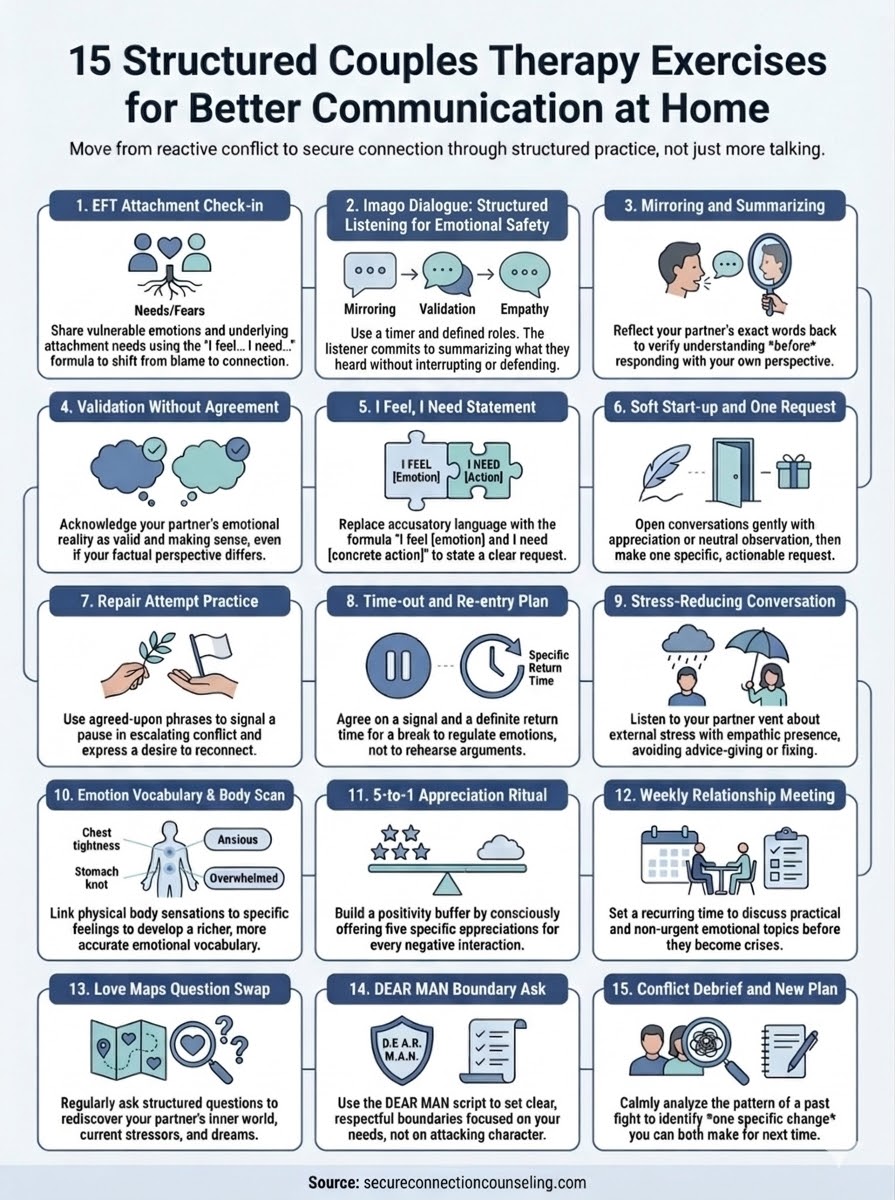
At Secure Connection Counseling, our work is grounded in Emotionally Focused Therapy and relational dialogue approaches that help couples understand the deeper attachment needs driving conflict. The practices below are not surface-level techniques. They are structured relational experiences designed to slow down reactivity, increase emotional attunement and connection, and help partners feel seen and understood.
Many of these practices are adaptations of what couples experience in therapy. When practiced consistently at home, they strengthen emotional safety between sessions — or serve as an entry point if you’re not currently working with a therapist.
The goal isn’t perfection. It’s a connection.
1. EFT attachment check-in
This exercise comes straight from principles of Emotionally Focused Therapy, one of the most research-backed models for couples work. Instead of focusing on behaviors or problem-solving, it helps you and your partner name the underlying attachment needs that surface during conflict. When you can express vulnerability rather than blame, you shift from criticism to connection.
What this exercise helps you change
You move from reactive arguing about surface issues to talking about the deeper emotional injuries underneath. Many couples fight about dishes, money, or who forgot what, but the real pain comes from feeling unseen, dismissed, or unimportant. This exercise teaches you to access and share those vulnerable feelings so your partner understands what you truly need.
“Conflict is rarely about the topic you’re arguing about. It’s about what that topic triggers in your attachment system.”
How to do it at home step by step
Set aside 20 minutes when you’re both calm. Sit facing each other without distractions. One partner goes first and completes three sentences: “When you [describe a specific behavior], I feel [name the vulnerable emotion], and what I need is [name the attachment need].” The listener paraphrases what they heard without defending or explaining. Then you switch roles and the other partner shares their version. Close by acknowledging one thing you each heard that you didn’t realize before.
Prompts that keep the talk attachment-focused
Use prompts that point to connection rather than criticism. Try “I feel lonely when we’re physically together but emotionally distant,” or “I need reassurance that I matter to you when we disagree.” You can also say “I feel scared that I’m too much for you,” or “I need to know you still choose me even when I mess up.” These statements reveal the attachment fear instead of attacking your partner’s character.
What to do if one partner shuts down
If someone withdraws during the check-in, pause and name what’s happening. The withdrawn partner can say “I’m feeling flooded right now and need a minute,” which keeps you connected even during the break. The pursuing partner can offer reassurance by saying “Take your time, I’m not going anywhere.” Resume the exercise when both of you feel regulated enough to continue, even if that means waiting until the next day.
When to bring this into couples therapy
Bring this exercise to your therapist if you keep circling the same fights without resolution, if one of you consistently shuts down or gets defensive, or if you suspect there’s an attachment injury from the past that neither of you can name alone. A trained EFT therapist can help you slow down the conversation and identify the cycle you’re stuck in.
2. Imago Dialogue: Structured Listening for Emotional Safety

Imago Dialogue is a structured, intentional conversation process that slows communication down enough for understanding to happen. Unlike typical back-and-forth arguments, this dialogue prevents interruption, defensiveness, and escalation by giving each partner a clearly defined role.
This is not just “taking turns.” It is a relational container designed to reduce threat and increase safety.
What this practice shifts
When couples argue, they often move into persuasion mode. Each person tries to explain, justify, or correct. The nervous system interprets this as danger. Once that happens, curiosity disappears.
Imago Dialogue shifts you out of persuasion and into presence.
Instead of asking: “Who’s right?”
You begin asking: “What is my partner experiencing?”
That shift alone changes the emotional climate of the conversation.
The Three Core Steps
Step 1: Mirroring
The Sender shares a short statement — ideally 1–3 sentences at a time.
The Receiver responds with: “What I’m hearing you say is…”
The Receiver mirrors content only. No interpretation. No rebuttal.
The Sender then confirms or clarifies until they feel fully understood.
This step regulates the nervous system because the Sender experiences being accurately heard.
Step 2: Validation
The Receiver says: “That makes sense to me because…”
Validation does not mean agreement. It means your partner’s experience has internal coherence from their perspective.
This reduces defensiveness and builds emotional safety.
Step 3: Empathy
The Receiver adds: “I imagine you might be feeling…”
The Sender confirms or adjusts.
Empathy activates emotional bonding and softens protective defenses.
Then partners switch roles.
Why the Structure Matters
The formality may feel unnatural at first. That’s normal. The structure is what creates safety. When each partner knows they will be heard before responding, urgency decreases. When urgency decreases, connection becomes possible.
This is often the foundation of deeper attachment work in therapy.
When to bring this into couples therapy
If mirroring feels impossible because anger overwhelms you, or if validation feels threatening because it seems like “losing,” that’s a sign deeper attachment injuries may be present. A therapist can help slow the process and identify the underlying emotional cycle.
3. Mirroring and summarizing

This exercise teaches you to reflect your partner’s words back before you respond with your own perspective. Instead of jumping straight to agreement, disagreement, or advice, you first prove you understood what they actually said. Mirroring creates a verification loop that catches misunderstandings before they spiral into bigger conflicts.
What this exercise helps you change
You replace reactive responses with intentional listening. Most couples argue past each other because they’re reacting to what they think their partner meant instead of what was actually said. Mirroring forces you to slow down and confirm understanding before moving forward. Your partner feels genuinely heard, which reduces their need to repeat themselves or escalate emotionally.
How to do it at home step by step
Partner A shares one complete thought in two or three sentences maximum. Partner B mirrors by saying “What I’m hearing is [paraphrase the content]” and waits for confirmation. Partner A either says “Yes, that’s it” or adds a clarification. Once Partner A confirms, Partner B can offer their own perspective or ask a follow-up question. Then you swap roles so Partner B gets to share and be mirrored.
Summary phrases that work in real fights
Use phrases like “So you’re saying that when I [action], you feel [emotion]” or “It sounds like you need [specific need] from me.” You can also try “What I’m hearing is that this matters to you because [reason]” or “You’re frustrated that I [behavior], and that makes sense.”
“Mirroring isn’t about agreeing. It’s about proving you’re tracking your partner’s experience accurately.”
How to avoid sounding sarcastic or robotic
Keep your tone neutral and curious rather than exaggerated or flat. Make eye contact and use your partner’s actual words mixed with your own paraphrasing. If it feels mechanical at first, acknowledge that by saying “This feels awkward, but I want to make sure I’m getting it right.” Authenticity matters more than perfect delivery.
When to bring this into couples therapy
Bring this exercise to your therapist if one of you consistently feels misunderstood, if summarizing feels impossible because emotions run too high, or if you struggle to distinguish between what was said and what you interpreted. A therapist can slow down the mirroring process and help you identify where communication breaks down.
4. Validation without agreement
This exercise separates understanding your partner’s experience from endorsing their interpretation of events. You can acknowledge that their feelings make sense from their perspective without abandoning your own truth. Validation doesn’t mean you agree or that you were wrong; it means you recognize their emotional reality as legitimate even when your memory or perspective differs. Validation is like taking off your partner’s glasses and looking at the worlf thorugh their lenses.
What this exercise helps you change
You stop the cycle where one person’s feelings invalidate the other’s. Many couples get stuck believing that if your partner’s perspective is valid, yours must be wrong. This exercise teaches you that both realities can coexist without one canceling out the other. Your partner stops needing to convince you they’re right because you’ve already acknowledged their experience matters.
How to do it at home step by step
Listen to your partner describe their experience without interrupting. Identify the emotion they’re expressing rather than the facts they’re claiming. Respond with a validation statement that acknowledges their feeling, then pause before sharing your own perspective. You can say “That makes sense that you’d feel [emotion] given how you experienced it” and then add “I experienced it differently” only after the validation lands.
Validation lines you can borrow
Try phrases like “I can see why you’d feel hurt by that” or “It makes sense you’re frustrated when you see it that way.” You can also use “I hear that this really matters to you” or “Your feelings are valid even though I remember things differently.”
“Validation isn’t surrender. It’s acknowledging that your partner’s internal experience is real to them.”
How to validate without self-abandoning
Hold onto your own truth while making space for theirs. You can validate their emotion without accepting blame for something you don’t believe you did. Say “I understand you felt dismissed, and that wasn’t my intention” rather than “You’re right, I dismissed you.” Your validation acknowledges their pain without requiring you to falsely confess. However…if there is accountability to be taken for one’s actions, this can be a very powerful validation! “I can totally see why you’d be worried that I would shut down, because I’ve done that a ton in the past!”
When to bring this into couples therapy
Bring this exercise to therapy if validation feels like losing, if one of you demands agreement before feeling heard, or if you can’t separate emotional validation from factual agreement. A therapist can help you practice holding both perspectives simultaneously without one partner feeling erased.
5. I feel, I need statement
This exercise gives you a two-part formula that expresses your emotional experience and makes a specific request in the same breath. Instead of criticizing what your partner did wrong, you name your internal response and state what would help. This structure is one of the most practical couples therapy exercises for communication because it shifts you from blame into vulnerability and clear asks.
What this exercise helps you change
You break the pattern of accusatory statements that put your partner on the defensive. Most conflict starts with “You never” or “You always” statements that trigger immediate pushback. This exercise teaches you to own your emotional reaction first, then translate it into a need your partner can actually meet. Your partner hears an invitation to help rather than an attack on their character.
How to do it at home step by step
Start with “I feel [name one emotion]” and pause to identify the specific feeling beneath your frustration. Then add “and I need [state one concrete action or reassurance]” that would address that emotion. Keep your need simple and doable rather than vague or impossible. Practice this structure out loud before a difficult conversation so it becomes automatic when emotions run high.
Examples for common couple pain points
Try “I feel lonely, and I need 15 minutes of conversation before bed” instead of “You’re always on your phone.” You can say “I feel anxious, and I need us to agree on a budget together” rather than “You’re terrible with money.” Another option is “I feel invisible, and I need you to ask about my day” instead of “You don’t care about me.”
“The formula works because it gives your partner something actionable instead of something to defend against.”
How to replace blame with a clear need
Catch yourself mid-blame and rephrase using the formula. If you start with “You ignored me all weekend,” stop and rebuild it as “I feel hurt, and I need more quality time with you.” Transform “You made me feel stupid” into “I feel embarrassed, and I need you to listen without correcting me in front of others.”
When to bring this into couples therapy
Bring this exercise to therapy if you struggle to identify your underlying emotions, if your needs feel too big to name in one sentence, or if your partner still hears blame even when you use the formula. A therapist can help you access the vulnerable feelings beneath your anger and shape your needs into requests your partner can respond to.
6. Gentle Emotional Entry
How you begin a conversation shapes the emotional outcome.
When conversations begin with accumulated frustration, your partner’s nervous system braces. When they begin with vulnerability, the nervous system softens.
This practice helps you move from criticism to emotional transparency.
What this practice shifts
Instead of: “You never help.”
You move toward: “I’ve been feeling overwhelmed and alone with responsibilities.”
The difference is subtle but profound. One invites defense. The other invites understanding.
How to practice at home
Before bringing up a concern, pause and ask yourself:
What am I actually feeling underneath my frustration?
What attachment need is underneath this complaint?
What is one clear request I can make?
Then structure your opening like this:
Emotional experience “I’ve been feeling anxious lately.”
Context “When plans change without notice, I feel unsettled.”
Clear request “Could we text each other earlier if schedules shift?”
One request at a time. One emotional entry point at a time.
Conversations that begin with emotional clarity are far more likely to end with connection.
7. Repair attempt practice
This exercise trains you to recognize and use repair attempts during escalating arguments. A repair attempt is any statement or action that interrupts the negative cycle and signals you want to reconnect rather than continue hurting each other. These moves work best when both partners agree to practice them during calm moments so you can deploy them automatically when conflict heats up.
What this exercise helps you change
You develop the ability to hit the brakes before an argument spirals into damage that takes days to recover from. Most couples miss or reject repair attempts because they’re too flooded to notice them or too committed to winning the argument. This practice teaches you to watch for and accept these bids for reconnection even when you’re still upset.
How to do it at home step by step
Write down three repair phrases you both agree sound authentic coming from your mouths. Practice saying them out loud to each other during a neutral moment. Choose one upcoming conversation where tension might arise and commit to using one repair attempt before things escalate. After the conversation, debrief whether the repair worked and what made it easier or harder to accept. The key here is agreement on what could work before you need it, so when you need to use a repair phrase, you both have already said that it would be helpful.
Repair phrases that de-escalate fast
Try phrases like “Can we start over?” or “I’m getting flooded, can we slow down?” You can also use “I’m sorry I raised my voice” or “This is important, I don’t want to blow it.” Another option is “Help me understand what you need right now” or “I care about you more than being right about this.”
“A repair attempt only works if the other person recognizes it and responds. You’re a team, not opponents.”
How to accept a repair without reopening the case
When your partner offers a repair attempt, pause before responding. Acknowledge it by saying “Thank you for saying that” or “I hear you trying.” Resist the urge to add one more point or remind them what they did wrong. Accept the repair as a gift that prioritizes the relationship over the argument.
When to bring this into couples therapy
Bring this exercise to therapy if you consistently miss each other’s repair attempts, if repairs feel manipulative or insincere, or if one partner refuses to accept any attempt at reconnection. A therapist can help you identify what blocks you from pausing conflict when your partner reaches for you.
8. Time-out and re-entry plan
This exercise gives you a structured protocol for pausing heated conversations before they cause lasting damage. Instead of walking away in anger or forcing yourself to push through when you’re overwhelmed, you create a shared agreement about how to take breaks that feel safe rather than abandoning. This is one of the most protective couples therapy exercises for communication because it prevents the type of flooding that makes repair impossible.
What this exercise helps you change
You replace reactive exits with intentional pauses that keep you connected even during separation. Many couples experience time-outs as punishment or abandonment because they happen without warning or agreement. This exercise transforms a break into a collaborative tool that both partners understand and respect as a way to regulate before continuing.
How to do it at home step by step
Agree on your time-out signal during a calm moment. Decide together how long the pause will last, typically 20 to 30 minutes for physiological calming. Set a specific time to reconvene rather than leaving it open-ended. During the break, do something that genuinely soothes your nervous system rather than rehearsing your argument. Return at the agreed time even if you still feel uncomfortable.
What to say when you need a pause
Use your pre-agreed phrase like “I need a time-out, let’s come back to this at 7:30” or “I’m getting flooded and need 20 minutes.” Avoid blame statements like “You’re making me crazy” or walking away without explanation. State your commitment to return by saying “This matters to me, I just need to calm down first.”
How to come back and finish the conversation
Start by acknowledging that you’re back as promised. Begin with appreciation like “Thank you for giving me space” before diving back into the content. Use a soft re-entry by asking “Where did we leave off?” rather than launching back into your point.
“The return is just as important as the pause. Coming back shows your partner the break wasn’t rejection. Otherwise, it becomes a withdrawal and both will not have their needs met.”
When to bring this into couples therapy
Bring this exercise to therapy if one partner uses time-outs to avoid resolution indefinitely, if breaks feel like punishment instead of regulation, or if you can’t agree on how long is reasonable. A therapist can help you identify what happens during the pause that prevents successful re-entry.
9. Stress-reducing conversation
This exercise creates a protected space where one partner can vent about external stress without the conversation turning into relationship conflict. You take turns being the stressed person and the supportive listener, with clear rules that prevent the listener from offering unsolicited advice or taking the stress personally. This is one of the most underused couples therapy exercises for communication because many couples skip straight to problem-solving when presence matters more.
What this exercise helps you change
You stop absorbing your partner’s stress as criticism of yourself or the relationship. When your partner vents about work, family, or other external pressures, you learn to offer support without defensiveness or fixing. Your partner gets to discharge emotional tension without worrying that their stress will start a fight between you.
How to do it at home step by step
Set aside 20 minutes when one partner needs to talk about external stress. The stressed partner speaks for 10 minutes while the listener maintains eye contact and offers small verbal affirmations like “That sounds hard” or “I’m listening.” The listener cannot offer advice, share their own story, or minimize the problem. After 10 minutes, ask “Is there anything specific you need from me?” and respond only to what they actually request.
The listener role and how to avoid fixing
Focus on empathic presence rather than solutions. Nod, make supportive sounds, and reflect emotions you hear without jumping into fix-it mode. Remind yourself that your partner already knows what advice you’d give, they need emotional connection more than problem-solving right now.
“Sometimes the most powerful thing you can do is simply witness your partner’s experience without trying to change it.”
How to prevent stress talks from turning into conflict
Keep the focus external by redirecting if the stressed partner starts criticizing you. You can say “I hear you’re overwhelmed, and I want to support you. Can we focus on what’s stressing you at work first?” If you feel attacked, use your time-out protocol rather than defending yourself during their stress window.
When to bring this into couples therapy
Bring this exercise to therapy if you can’t distinguish between external stress and relationship complaints, if the listener takes everything personally, or if stress conversations consistently escalate into fights. A therapist can help you identify why offering presence feels threatening or insufficient to either partner.
10. Emotion vocabulary and body scan
This exercise expands your ability to name internal states beyond the basic emotions most people default to during conflict. You combine emotional labeling with body awareness to help you describe what’s happening inside when words like “mad” or “fine” don’t capture the full picture. Many couples therapy exercises for communication focus on what to say, but this one teaches you how to access what you’re actually feeling before you speak.
What this exercise helps you change
You move past surface-level emotion words that keep you stuck in the same arguments. When you can only identify “angry” or “upset,” you miss the vulnerable feelings underneath like scared, lonely, or helpless. This exercise helps you develop a richer emotional vocabulary and connect feelings to physical sensations, which makes your communication more specific and harder for your partner to dismiss.
How to do it at home step by step
Pause during a calm moment and scan your body from head to toe, noticing tension, heat, or tightness. Name the physical sensation first, like “My chest feels heavy” or “My jaw is clenched.” Then match that sensation to a specific emotion using a feelings list if needed. Share both the sensation and emotion with your partner by saying “I notice my shoulders are tight, and I think I’m feeling anxious about our conversation.”
Words that help you get specific beyond mad or fine
Replace “mad” with words like frustrated, resentful, or betrayed depending on what fits. Instead of “fine,” try relieved, cautious, or hopeful. Other useful words include overwhelmed, dismissed, protective, ashamed, tender, or guarded to capture the nuance your basic vocabulary misses.
“The more precise your emotional language, the easier it becomes for your partner to understand and respond to your actual need.”
How to share sensations without sounding dramatic
Describe sensations as neutral observations rather than exaggerations. Say “My heart is racing” instead of “I’m having a panic attack.” Use phrases like “I feel a knot in my stomach” rather than “This is killing me.” Keep your tone matter-of-fact when linking body and emotion.
When to bring this into couples therapy
Bring this exercise to therapy if you consistently feel numb during conflict, if your partner accuses you of being overdramatic when you name feelings, or if you can’t identify emotions beyond anger. A therapist can help you build your emotional vocabulary and learn to trust your body’s signals.
11. Daily Appreciation Ritual
Relationships naturally develop a negativity bias under stress. The brain scans for threat faster than it notices safety. Over time, this can distort how partners perceive each other.
Intentional appreciation counterbalances this.
What this practice shifts
Instead of focusing primarily on what’s missing, you deliberately notice what is working. This builds emotional goodwill and resilience.
Appreciation is not flattery. It is accurate noticing.
How to practice
Once per day, offer one specific appreciation:
Name the behavior.
Name why it mattered.
Keep it concrete.
Example: “I appreciated that you checked in before my presentation. It helped me feel supported.”
The receiving partner responds with: “Thank you.”
No deflection. No minimizing.
Receiving appreciation is often harder than giving it. Both matter.
Over time, this ritual rebuilds positive regard and emotional safety.
12. Weekly relationship meeting agenda
This exercise establishes a recurring time slot where you and your partner address practical issues, make plans, and check in emotionally before small frustrations accumulate into major conflicts. Instead of bringing up problems randomly throughout the week, you save non-urgent topics for this designated meeting. The structure prevents relationship maintenance from feeling like constant work while ensuring important conversations actually happen.
What this exercise helps you change
You stop the pattern of reactive problem-solving where issues get discussed only when they explode into crisis. This exercise gives you a predictable container for addressing concerns before they become urgent. Your relationship shifts from crisis management to proactive maintenance, which reduces the frequency and intensity of spontaneous arguments.
How to do it at home step by step
Choose the same day and time each week, ideally 20 to 30 minutes when you’re both relatively fresh, and it should not be during date night or other moments intended for enjoyment and connection. Start with appreciations from the past week, then review your shared calendar and upcoming commitments. Address one or two practical issues like finances, household tasks, or scheduling. Close with a brief emotional check-in about how you’re feeling about the relationship and each other.
Topics to cover in 20 to 30 minutes
Include what went well that week, what needs attention, upcoming events that require coordination, and any resentments or appreciations you’ve been holding. You can also discuss intimacy, division of labor, or progress on shared goals. Keep each topic time-limited so no single issue consumes the entire meeting.
“Regular meetings normalize talking about your relationship, which makes difficult conversations feel less threatening.”
How to keep the meeting from becoming a complaint session
Start with three appreciations before introducing problems. Frame issues as “What can we improve?” rather than “What’s wrong with you?” Limit complaints to one per person and pair each with a specific request for change.
When to bring this into couples therapy
Bring this exercise to therapy if meetings consistently derail into arguments, if one partner refuses to participate, or if you can’t agree on what topics belong in the meeting versus everyday conversation. A therapist can help you structure meetings that feel productive rather than punishing.
13. Love maps question swap
This exercise uses structured questions to help you rediscover each other’s inner world. Love maps are the mental frameworks you build about your partner’s daily reality, dreams, and fears. The question swap gives you a playful format to update those maps when life changes faster than your knowledge of each other. Many couples therapy exercises for communication focus on conflict, but this one prioritizes curiosity.
What this exercise helps you change
You reverse the drift toward parallel lives where you share space but stop knowing what matters to each other. When love maps fade, partners become strangers who can coordinate logistics but can’t offer meaningful support during stress. This exercise rebuilds the detailed knowledge that creates emotional intimacy and makes your partner feel genuinely seen.
How to do it at home step by step
Set aside 15 minutes and take turns asking each other questions from different categories. Each person answers fully while the other listens without commentary. Aim for four to six questions per session rather than rushing through a long list. Schedule this weekly or biweekly to keep your maps current as life evolves.
Question categories that build closeness quickly
Ask about current stressors like “What’s weighing on you this week?” or future dreams like “Where do you see yourself in five years?” Explore values by asking “What matters most to you right now?” or daily life with “What part of your routine do you look forward to?”
“Knowing your partner’s world in detail is what separates intimate relationships from functional partnerships.”
How to use this when you feel like roommates
Start with low-stakes questions about preferences or daily experiences before diving into emotional territory. Questions like “What’s your favorite meal this month?” or “What would make your mornings easier?” rebuild connection without overwhelming either person.
When to bring this into couples therapy
Bring this exercise to therapy if questions feel interrogative rather than curious, if answers feel performative, or if you realize you don’t know basic facts about your partner’s current life. A therapist can help you identify what blocks genuine interest in each other.
14. DEAR MAN boundary ask
This exercise comes from Dialectical Behavior Therapy and gives you a structured script for setting boundaries without attacking your partner’s character. DEAR MAN stands for Describe, Express, Assert, Reinforce, Mindful, Appear confident, Negotiate. The acronym helps you remember each component when you need to make a difficult request or protect your limits. Unlike vague boundary discussions, this formula keeps you focused and respectful even when emotions run high.
What this exercise helps you change
You replace unclear boundary violations with specific, actionable asks that your partner can understand and respond to. Many couples struggle with boundaries because requests sound like character attacks or the boundary itself remains fuzzy. This exercise teaches you to state your limit clearly while staying connected to your partner rather than creating distance through passive aggression or withdrawal.
How to do it at home step by step
Write out your boundary using the DEAR MAN structure before speaking. Describe the situation factually, express how it affects you, assert your specific request, and reinforce why it matters. Stay mindful by returning to your script when your partner responds, appear confident through steady tone and posture, and negotiate by offering alternatives or compromises if your first request isn’t workable. Practice the full script twice alone before delivering it to your partner.
Examples of clear boundaries that stay respectful
Try “I need you to text if you’ll be more than 30 minutes late so I can plan dinner accordingly” instead of “You’re always late and it’s disrespectful.” You can say “I need to finish work calls without interruptions unless it’s an emergency” rather than “You never respect my work.” Another option is “I need us to discuss major purchases over $200 before buying” instead of “You’re terrible with money.”
“Clear boundaries protect the relationship by preventing resentment from building silently over time.”
How to handle pushback and negotiate
Listen to your partner’s concerns without abandoning your core need. Ask “What would make this easier for you?” to invite collaboration. Offer flexibility on timing or method while holding firm on the boundary itself. If they dismiss your request entirely, return to expressing why it matters using your original script.
When to bring this into couples therapy
Bring this exercise to therapy if your partner treats all boundaries as controlling or unreasonable, if you can’t identify what your actual limits are, or if negotiation feels like losing. A therapist can help you distinguish between healthy boundaries and attempts to control your partner’s behavior.
15. Conflict debrief and new plan
This exercise happens after a fight rather than during it. Instead of pretending the argument never happened or jumping straight back to normal, you set aside time to analyze what went wrong and identify one specific change for next time. The debrief turns recurring conflicts into learning opportunities rather than proof that your relationship is broken.
What this exercise helps you change
You break the cycle of repeating the same fight with different surface topics. Most couples argue about the content of their disagreements without examining the underlying pattern that keeps them stuck. This exercise teaches you to step back and identify the predictable sequence that escalates conflict so you can interrupt it before damage occurs.
How to do it at home step by step
Wait until you’re both calm, typically 24 hours after the conflict ends. Set a timer for 20 minutes and agree to focus on the process rather than relitigating who was right. Each partner answers the debrief questions while the other listens without defending. Close by choosing one concrete change you’ll both try during the next disagreement.
Questions that find the pattern under the fight
Ask “What did I do that escalated things?” and “What was I feeling right before I got reactive?” You can also explore “What did I need that I couldn’t ask for?” or “What would have helped me stay regulated during that moment?”
“The content changes but the dance stays the same until you name the pattern together.”
How to agree on one change for next time
Choose something small and specific like “I’ll use our time-out signal when I feel flooded” or “I’ll validate your feeling before sharing my perspective.” Avoid vague commitments like “I’ll be nicer” that you can’t measure. Write down your shared commitment where both of you can see it.
When to bring this into couples therapy
Bring this exercise to therapy if debriefs turn into new fights, if you can’t identify any patterns, or if one partner refuses to acknowledge their role in the cycle. A therapist can help you see the interaction pattern you’re too close to notice alone.
Next steps
These exercises are not quick communication tricks. They are structured relational practices designed to create emotional safety, increase attunement, and reduce reactivity.
You do not need to implement all 15 at once. Choose one that fits your current dynamic and practice during calm moments. The nervous system learns through repetition.
If you find that structured conversations repeatedly escalate, or that vulnerability triggers shutdown or defensiveness, that often points to deeper attachment patterns. Those patterns are not failures. They are protective strategies developed over time.
At Secure Connection Counseling, we work with couples to understand and transform those protective cycles so partners can move from conflict toward secure connection. When structured dialogue is paired with guided therapeutic support, change becomes more sustainable and more meaningful.